Spoiler alert! If you haven’t seen Wicked: For Good yet, click away! This is part 1 of a three-part series; here, we will focus on female friendship.
Along with the rest of the universe, I just went to see Wicked: For Good. I met my two best friends through amateur musical theatre; one of them was the Glinda to my Elphaba in a rendition of For Good in 2018. Seeing this film together was absolutely a rite of passage.
The first film in the series obviously left us riding the high of Defying Gravity, Elphaba’s rebellion song, as she flies away from the Emerald City on her new broomstick with the Grimmerie (Oz’s famed book of spells) in tow. The Wizard is a fraud and Glinda decides to stay with him and the truly heinous Madame Morrible, who wasted not a second in scapegoating Elphaba to the public in order to keep the Wizard’s name clean.
When I saw the stage production, I remember thinking that Act 2 sort of rushes through all the action and revelations – the identities of the tin man and scarecrow, for example, and the general ‘kill the witch’ rhetoric, after a slower and calmer Act 1. As much as I enjoy it, it always seems a bit unbalanced. So I was expecting the same from Wicked: For Good. A rush, too much action, not enough time to breathe.
However, I actually thought that Jon M. Chu has done a great job of slowing down and fleshing out this half of the story as well. It didn’t feel like my eyeballs were being slapped with event after event.
That being said, I want to discuss some of the main themes rather than the acting (very good), the singing (even better), or the general thinness of the main characters (rather concerning), which has been turned over ad infinitum. Let’s talk female friendship, folks.
Female Friendship
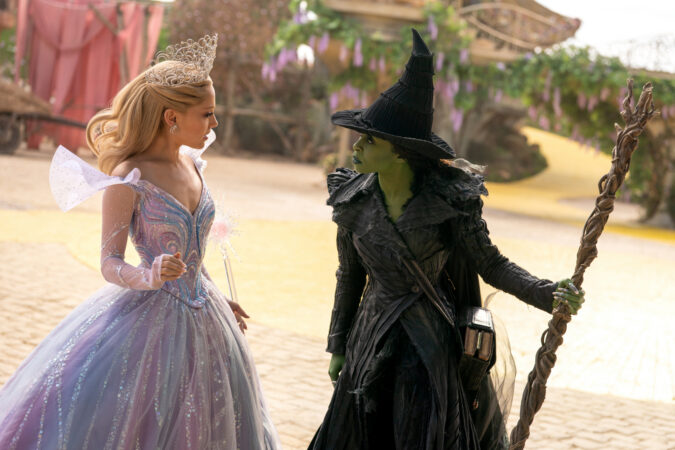
I’ve heard it said (see what I did there) that Elphaba and Glinda are the gold standard of girlfriends. Two powerful women supporting each other through thick and thin, right? In a world where strong, deep and complex female friendships are underrepresented in the media, this ‘power couple’ seem to stand out, especially as Ariana Grande and Cynthia Erivo are seemingly joined at the hip.
When I think about my own female friendships, the women I love most in the world, I think about how they have saved me. I think about how my best friend Lorna (Glinda to my Elphaba, incidentally) helped me to feed my new baby two days postpartum as my hormones crashed and I could do nothing but sob. She has loved my baby since the minute she knew he existed. I think about how we always go to watch our other best friend Michelle perform in shows, how we sing karaoke together and cheer for each other, how they both turned up at the hospital (a very long drive for them) when I was hospitalised with sepsis two weeks postpartum and my marriage had broken down. I think about my beautiful ‘mum friends’ who have become integral parts of mine and my son’s life, about how when I needed parenting help they were always there, the amount of times we have cried over coffee, the way our babies have grown up together. I think about how my bestie and fellow mum Emilia always tells me the truth, no matter how hard it is for me to hear, but how she holds my hand through it, usually nowadays at a playgym (mum life!). I think of the way she loves my son as her own, and the way he sits on her knee and calls her Meemaw. I think about Kelly, who has known, loved and supported me without question since I was 21, and who has always just accepted me exactly as I am. These are women I would quite literally do anything for, and who would do anything for me. Our bond is collaborative, and based on mutual respect and love and gentle but firm truth. I would never compete with these beautiful women; their wins are my wins.
Then I consider Elphaba and Glinda. Two friends who have absolutely nothing in common in terms of values and beliefs. Two women whose relationship is dominated by romantic and magical rivalry. In the first film, Glinda tries to humiliate Elphaba, already a social pariah due to her green skin, by giving her a hideous hat to wear to the Ozdust ballroom. Then, when Elphaba is ridiculed, she feels guilty. Her next step – dancing publicly with Elphaba – is sometimes seen as her sacrificing her social standing. But I think it’s absolutely crucial to realise that she is sacrificing nothing. Glinda knows that she is the social elite and in a position of complete privilege; she can invite Elphaba into her world by publicly accepting her at no cost to herself. She then sings the iconic Popular, in which she attempts to make Elphaba palatable by giving her a popularity masterclass and makeover. Narcissism and myopia at its finest; look and act like me and you’ll fit right in! There is a not-so-subtle nod here to the concept of code-switching, which is where minority groups feel the pressure to alter their behaviour and presentation in order to avoid discrimination in a world where ‘whiteness’ is the cultural standard. Elphaba is the most talented and powerful witch at Shiz, yet she is treated as an outsider simply because her skin is green. Glinda even acknowledges the element of competition and hierarchy at the end of Popular – ‘just not quite as popular as me’ – unlike Elphaba, who puts her all-important education on the line to include Glinda in her sorcery lessons. In contrast, throughout both films, Glinda never puts herself in a position where her friendship with Elphaba could affect her social status or privilege. Elphaba is ruled by her sense of moral justice, and Glinda is ruled by the need to be liked. Fiyero points this out – ‘you can’t leave, because you can’t resist this […] we both know who could.’ Elphaba spends the whole of Wicked: For Good as an outcast, flying about desperately trying to enact social change, whilst Glinda sits pretty on the inside, cosying up to the Wizard and doing Madame Morrible’s bidding. Ultimately, yes, she finally uses her power to do the right thing by banishing the Wizard and Madame Morrible and welcoming back the animals, but she retains her ‘goodness’, crown, riches and adoration whilst Elphaba wanders off through the desert. I know that Elphaba asks her not to clear her name, but as we saw at Shiz, Glinda would have been more than capable of doing so without really affecting her own status. This is so reminiscent of Malcolm X’s speeches and opinions on the white liberal – those who consider themselves ‘allies’ but still continue to maintain power and control without ever challenging the structures that actually uphold systemic racism. Sound like anyone we know?
Speaking of Fiyero, let’s address that whole mess!
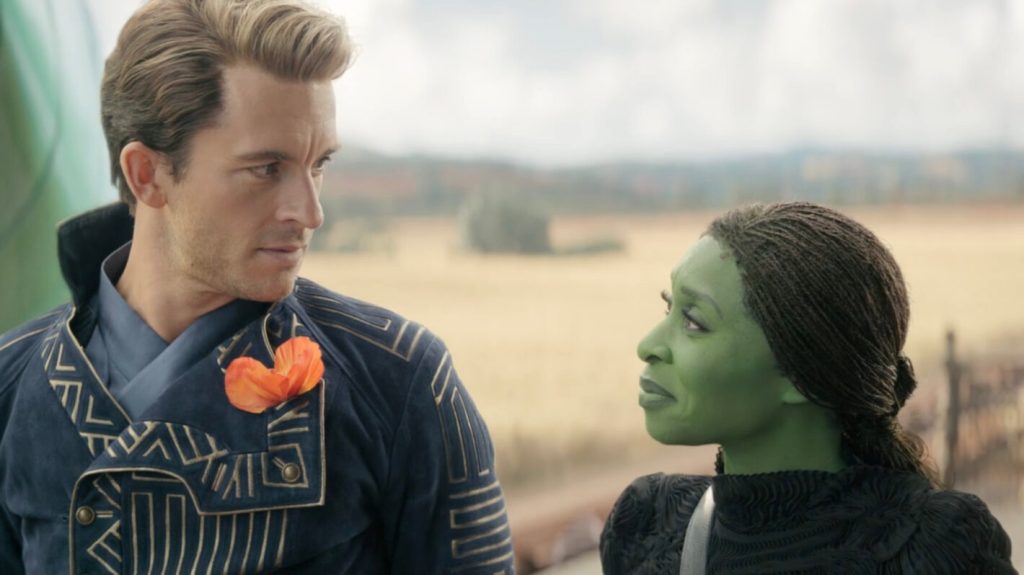
Fiyero initially chooses to date Glinda, presumably because they’re both popular, good-looking and shallow, and as Hilary Duff iconically states in A Cinderella Story, people like that ‘seem genetically programmed to find each other’. However, it turns out that Fiyero is actually not that shallow and has much more in common with Elphaba, so after a couple of longing looks and a mounful song from her, he leaves Glinda at the alter to be with Elphaba.
I am all in favour of being with the person you truly love, for sure. But maybe not like this! Sleeping with your alleged best friend’s fiancé on their wedding night is a bold move! I can understand, as Elphaba actually says to Glinda later in the film, that the fact that the handsome prince chose the wicked witch over the little blonde princess must have come as a shock to said little blonde princess, because she is so completely assured of her superiority both in character and beauty. This heavily hints at the idea that Western standards of beauty have historically been based on ‘white’ features, and people of colour have often been expected to assimilate, to straighten their hair and lighten their skin, in order to be considered beautiful by these standards. Elphaba initially wishes to be ‘degreenified’ by the Wizard, after all. There’s also that distinct element of competition that is so not welcome in true friendships creeping in once again. And it’s so understandable, from Elphaba’s perspective, after being so alone and so badly treated for so long, that she would jump at the chance to be loved. To be fair to Glinda, she’s actually pretty gracious about the whole thing, but not before taking her revenge by advising Madame Morrible to put Elphaba’s beloved sister Nessa in harm’s way. Shots fired.
I think one of the things that seems to cement this friendship in the zeitgeist as so pure and powerful is probably the beauty and tenderness of For Good. Here, they state that they are forever changed by their relationship and even ask each other for forgiveness. They show each other kindness and understanding. But is it enough to overcome the toxicity of what has come before? The competition and humiliation, the betrayals, the literal physical fight at one point? Glinda is able to do the right thing by the animals and overthrows the wizard and his henchwoman, whilst Elphaba leaves with Fiyero, forever to be remembered as the Wicked Witch of the West in her homeland – a place that she sang about in ‘No Place Like Home’ as being irreplaceable and worth fighting for. Glinda replaces her crown and Elphaba… leaves. Wait a minute. In what way has Elphaba been changed by Glinda? Her values and principles have remained the same throughout. She has accepted her own powerlessness in an oppressive system and left, and once again, Glinda benefits from Elphaba’s innate sense of moral justice. Glinda the Good, singlehanded overcomer of wickedness and fascism! Elphaba’s total invisibility here speaks to a long history of whitewashing, and the erasure of people of colour and their accomplishments in favour of white people. Elphaba sadly acknowledges it in For Good – ‘I’m limited. And just look at you, you can do all I couldn’t do.’ Not because Glinda is in any way superior, but because she was born with advantages that Elphaba cannot access.
I think their ‘friendship’, rather than being a great example of women supporting women, is actually a wonderful exploration of exploitation, systemic racism, inequality and privilege. As much as Glinda likes and admires Elphaba on a personal level, their friendship perpetuates rather than corrects the inequality Elphaba experiences, and Glinda props up the system that allowed Elphaba to be so othered and discriminated against in the first place, based entirely on the colour of her skin.
 The Station
Leave a comment